Wednesday, February 20, 2013

Common sense is not so common


'Golden Crookneck' summer squash.

The proverbial has hit the fan. The horse#%@* that is.

Our industrialised, regulated food system is SO screwed up.

It is illegal for me to use second hand egg cartons and, despite a whole evening of googling, I could only find one reference to the possible danger of used egg cartons (on a website for paranoid parents, warning them of the dangers of using said cartons for their children’s craft activities). But while being subjected to regulations like these, we are legally sold food that has been bleached, irradiated, extruded and sprayed to keep us ‘safe’, and somebody finds Black Beauty in the frozen lasagne.

Call me strange, but I wouldn’t recoil at the thought of eating Black Beauty, providing she had been humanely raised and fed a healthy diet, any more than I recoil at the idea of eating an egg from a second hand carton. The problem for me is the homogenisation of food products from around the world to such a point that we can't recognise what we are buying. Surely horse doesn't taste like beef? But since things are minced, doused with chemical seasonings and standardised to all taste the same to our industrially dumbed down palates, nobody notices. 

The industrial system is not capable of protecting us from listeria, salmonella, E.coli and antibiotic resistant bacteria. What it is capable of is spreading these things far and wide. Just have a think back to the tragic E. coli outbreak in Germany in 2011. This wasn’t caused by an unpasteurised cheese, a second hand egg carton or nitrate free ham. In fact, as far as I can tell, due to the massive movement of food across the globe, the source still seems unclear with Spain, Germany and Egypt all thought to be sources of contamination at some point during the investigation. I found an article on an outbreak of Salmonella in the UK that was blamed on ready to eat, pre sliced watermelon shipped there from Brazil. Isn’t that the perfect caricature of our energy expensive, wasteful, ridiculous food system? Is it so hard to ship something in its own skin and use a knife yourself?

One of the reasons I am so determined to make our garden work is that I believe it is the antithesis of this. Land that would otherwise be used for recreational horses or lawn mowing, instead producing heaps of really good food. Little, labour intensive food production systems feeding as many local people as possible with minimum carbon and waste outputs, and maximum flavour, nutrition, diversity and joy.

Only a small scale market garden can feed their pigs and chickens on apples, blackberries, thistles and spent vegetables produced on site. Manure goes back into the garden and the animals perform tillage and pest control services. On a plot our size, many more than the twenty chickens and two to three pigs we keep could begin to compact the soil. The manure we produce, without our garden to use it in, would become a waste disposal problem, the weeds and bolted vegetables we end up with would be harder to compost and process without the animals. Our garden is becoming a balanced ecosystem that, as we build soil and our skills and experience grow, I hope to make as efficient and beautiful as possible. Spare plants from the nursery go to our kid's school garden, neighbours come by with their scraps for the animals and our kids are learning about flavour, nature and hard work.


Rillettes hard at work.

Our small garden also guarantees that when I pass your change across my market table you will see the soil that grew your vegetables stuck under my nails. You can challenge me about the brand of seeds I use, or about my excessive use of sticky tape. You can ask me how I treat my soil, or what the strange leaf is in your salad.

But, next year I probably won’t be able to sell you eggs. A new egg act that comes into place late this year I think will make it unviable for me. Our chickens are a truly important part of our garden ecosystem, selling the eggs helps to balance the cost of supplementary feed. From what I understand I’ll need to individually date stamp each egg, submit and pay for inspections as well as paying a registration fee of more than $300 a year. As small producers our time is, and should be, taken up digging, watering, growing and marketing our goods. There is no way I have time to read and understand the act, certainly no time for me to attempt to fight it, and, more than likely, no chance of success if I did find the time. Sure, my friends say I can go underground and sell the eggs privately, but why shouldn’t my loyal and beautiful market customers who have built up trust with me and my methods be able to choose to buy my food and instead, be forced to buy from a producer who has the economy of scale to manage the costs of the new system? This is just my example of red tape hampering productivity and the sharing of real food, there are many more small producers out there with similar fights on their hands. We are taking responsibility for our family and our land, hoping to create employment for ourselves, food for others and be part of Tasmania's spectacular food culture.


Tasmanian Tree Frog and French sorrel.

This, in a world where our food systems are such that waste is an integral part of them. Where packaging is more important than contents, and labelling that gives us the option to make informed choices is not law. Where bleach, irradiation and vacuum packaging take the place of freshness and hygiene, and the rights of multinational companies to trade across borders transcends our right to know what we are eating.

We need a food regulation system that can cater for all producers, not just the large ones, and enable small farms who priorotise soil health, animal welfare, carbon sequestration and flavour to thrive. The current one that seems to favour big, energy and waste intensive, industrial food. Small farms like ours are key to true food security. Small scale farms rely on personal interactions, trust and common sense to keep food safe, not reams of paper, registration fees and legislation. Value adding on small farms needs to be easier, to sell a few jars of jam or honey in the quiet months of the year would require us to build or hire a commercial kitchen, outweighing any much needed financial advantage we may gain.

It is an unnatural, nonsensical environment we have created, where a gardener can’t make jam in their own kitchen to sell at market, but beef/horse can turn up in your microwave from goodness knows where.  

We need legislators to fight our corner for us, as we are too busy digging, and we need to take ownership of the fact that what we buy shapes the world we live in.

I am writing from my heart, no references or sensible things like that here, but here are a few things, in the order in which I discovered them, that resounded with me and shaped my thinking on food.

Living the Good Life, Linda Cockburn

Real Food, Nina Plank

Animal, Vegetable, Miracle. Barbara Kingsolver

Food Inc.

Eating Animals, Johnathon Safran Foer

Also pretty much everything on the blog roll on the right of your screen, there are many inspiring and incredible people fighting the good fight!

Nick's wonderful discussion of how he sources his milk.

And finally, this lovely rant shared on Facebook this week by Elaine and Colette.

You may also have noticed we're at Farm Gate Market in Hobart with our produce and ever growing range of edible plants every single Sunday! The chef has left the kitchen and has become a full time food gardener, so expect to see our stall brimming with wonderful food over the coming months.


Underground bulbs of walking onions and winter savoury.
Both hardy and easy to grow, both utterly delicious.

Saturday, December 8, 2012

Chilli plants


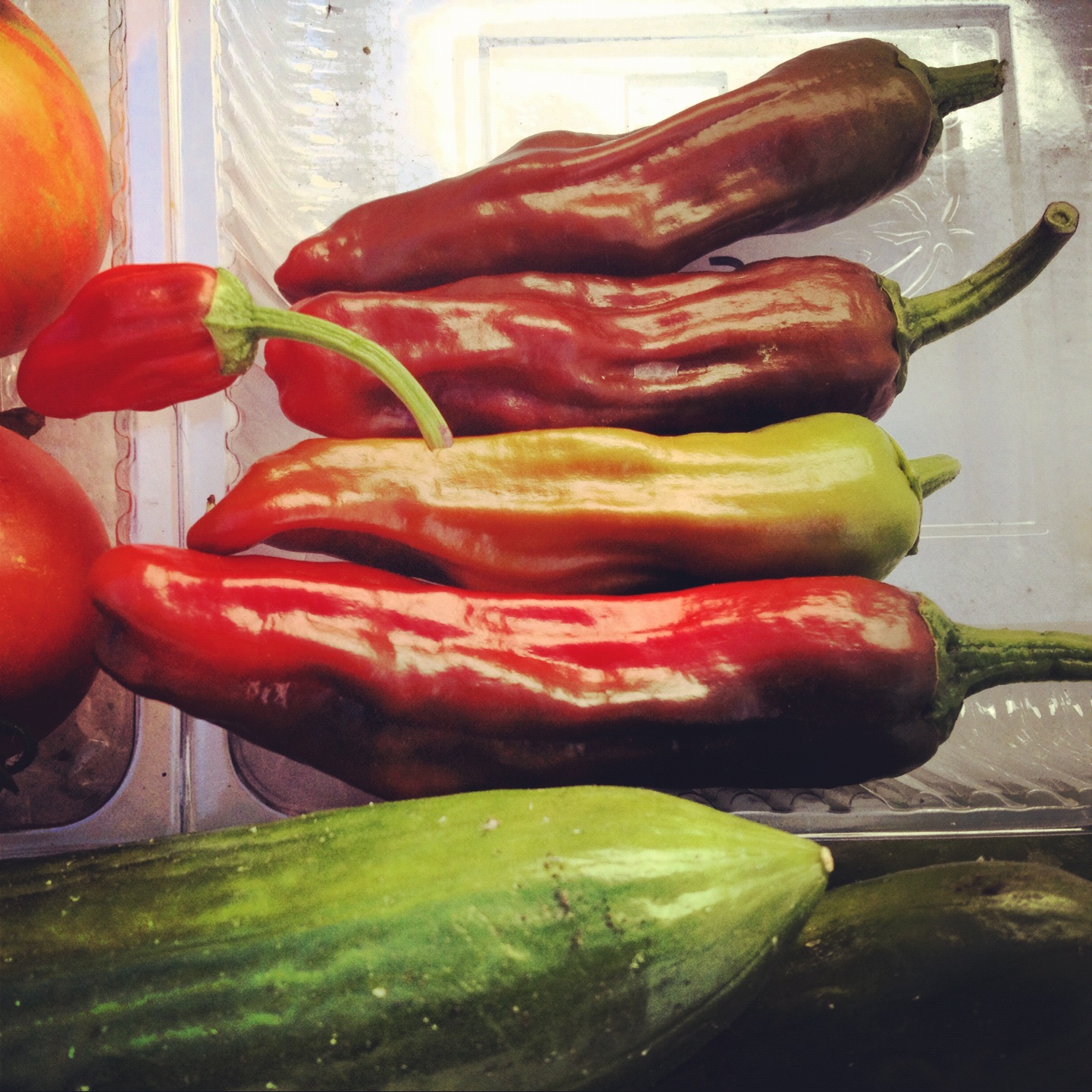
I've just finished packing the chilli and capsicum plants for market tomorrow. Some varieties are old friends that we have grown and enjoyed over previous summers, others are new to us, but all sound delicious. We grow most of ours in an unheated polytunnel with mesh walls, but they are all easily grown outdoors in a warm sunny garden or in pots. Potted plants can also be moved indoors at the onset of cold weather for an extended harvest. 


Alma Paprika, unripe fruit and flower.
Plant them into good, rich soil and remove the first few flowers to encourage the plant to put some energy into growing before it begins fruiting. All varieties can be harvested green or red, and, if protected from frost, your plants will continue fruiting well into winter. Our pantry is well stocked with little jars of dried chillies and bottles of chilli plum sauce, and the odd jar of pickled peppers is still lurking in the fridge. The most precious one for me is our paprika. When dried it forms luminous, dark red flakes and smells sweet, rich and complex.


Friggitello Italian frying pepper, harvest while green and grill, then finish with salt and a little vinegar, or allow to ripen to red and use in salads. Mild.

Padron Spanish frying pepper. Mild with the occasional hot fruit giving them the nickname of 'Russian Roulette Pepper'. Grill over coals or fry in oil and finish with salt. Most rate at 500 on the Scoville scale with the occasional fruit getting up to 25,000.

Ciliegia or Devil’s Kiss Italian medium/hot pepper with small, round red cherry-type fruit. Good for stuffing, fresh eating or pickling.

Hot Paper Lantern Cool climate alternative to Habanero for hardcore cooks. Red, wrinkled HOT fruit. Grows well in pots. Scoville rating of 400,000 - 450,000

Calbrese Another hot, Italian cherry type. Use fresh, fried, pickled or dried.

Alma Paprika A favourite of mine, use fresh or dried. Red, round, warm but not super hot fruit with a rich flavour. 100-1000 on Scoville scale.

Drying our first harvest of Alma Paprika.

Pepperoncini Another good performer at Neika. Thin walled pepper with great flavour and a little warmth, bred for pickling, also great dried. 


Pepperoncini


Beaver Dam Hungarian heirloom, warm to hot flavour, great for pickles and salsas. Suited to cool climates. 500-1000

Antohi Romanian Romanian heirloom, introduced to North America by Jan Antohi, an acrobat, when he defected. Mild, sweet flavour suited to eating fresh or fried. Can be picked at the yellow stage or left to ripen to red. Gets a zero on the Scoville scale.

Rocoto Perennial tree chilli. If protected from frost this pepper will fruit all winter. It produces great crops of hot, round peppers. May grow to 4m but easily pruned to a manageable size. Withstands cool temperatures, but not frosts. 50,000 to 200,000


Rocoto


Cayenne Good producer of long, red, hot peppers. Use fresh or dry for year round use. 30,000-50,000 Scoville points.


Find us at Farm Gate Market every Sunday from now until Christmas with these, loads of other wonderful plants and produce, along with gift vouchers and edible plants in vintage terracotta pots.


Friday, November 2, 2012

Picking flowers


Today is pick day. It's still early in the season, and tiny green shoots, radishes and flowers are at their peak. The last of the winter roots and stored squash are finished and summer vegetables are still in their seedling pots, hardening off in the spring sun.

But there's still a bounty to be found. We crawl, on hands and knees, through the garden seeking out tender leaves of chickweed, delicate, sweet and peppery radish flowers complete with buds and succulent stems, baby red orach leaves, tips of Lebanese cress, anisey, green seeds of sweet cicely and little leaves of lemon liquorice mint with their strange scent of jelly babies.

Where we live and garden, on the lower slopes of Mount Wellington, we are surrounded by wilderness and the soundtrack to our work is provided by swarms of bees who don't seem bothered by us stealing their flowers. Currawongs sit in the dead stringybarks at the top of the hill and sing their nine-note, off-key song, plovers occasionally rise from their nests in the paddock to fly shrieking at any hawk or falcon that dares enter their airspace. Closer to hand, wrens pause from hunting aphids on the quince tree and sing with a fervour that belies their size, and robins sit on the handle of my fork watching us closely on the off chance we might unearth a worm, letting out the occasional trill to remind us to look up from our work and admire their crimson bellies.

Native hen eggs, this nest is right next to our pumpkin patch.
The tidbits we gather are off to our favourite restaurants, some for Garagistes, The Stackings at Peppermint Bay and for The Source and events at Mona. On Saturday afternoon I'll pick these same leaves and flowers for Farm Gate Market as salads for you to take home. And while this is all happening, I'm feeling grateful to have started a garden like ours, in Southern Tasmania now.

Last fortnight's version of our Farm Gate salad.

The food culture that is blossoming here is in tune with how we want to work. Chefs who demand unusual produce contribute to biodiversity. A few years ago it was rocket or mesculin mix in a salad when you went out for dinner. Now, through the seasons, we would offer local chefs more than 70 different greens.  This allows us to use what grows with no need for lights, green houses, chemicals or other interventions needed to grow things out of season and gives us the chance to experiment with new or forgotten plants.

Today I've picked radish flowers for a chef to match with rillettes for a special picnic. The peppery, juicy stems and buds will be the perfect foil for the rich meat. Chervil and sweet cicely flowers have gone out to meet a chocolate dessert. Stock flowers that have the scent of your Nanna's perfume (in a good way) will meet some similarly sweet crab. The chefs we grow for only put flowers on a plate when they will add something to a dish, be it texture, fragrance or flavour. The good looks are just a bonus so please don't push them to the side of your plate, savour them!

So thank you to the people of Hobart, chefs, their patrons and our market friends alike, for embracing the unusual, eating flowers and weeds with us, and allowing us the chance to work with the flow of the seasons in this beautiful place where we live.


This Sunday, the 4th of November, we're doing an extra Farm Gate Market and we'll have some of these greens and flowers for you to take home. We'll also have more varieties of tomato, possibly over 20 for you to choose from this week, and the first of our chilli and pepper seedlings.

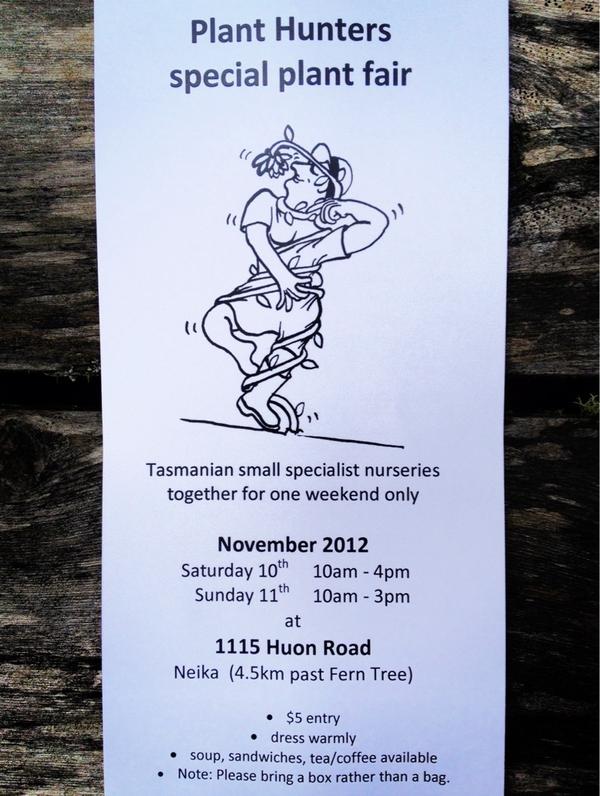
The following weekend, on the 10th and 11th of November, we'll be at the Plant Hunter's Fair in an incredible garden at Neika, see the flyer below, and at Farm Gate as usual on the 11th.


Peppers for Farm Gate this week. Find a warm spot, dig in some compost and chill the beers...

Friday, October 26, 2012

2012 tomatoes, first varieties.


Show Day has been and gone, and many Hobartians are rushing out to get their tomatoes in, but beware, frost may still strike. If you do plant now, and you live in a frost prone area, grab yourself a lace curtain from the opshop and use it, draped over some stakes to protect your plants from light frosts.

The first of our tomatoes are ready for planting, and have been hardened off exposed to all the windy, cold rainy weather we've had. These will be at Farm Gate Market with us this Sunday, the 28th of October, and there are quite a few more coming over the next couple of weeks, and chillies, capsicums and eggplants galore on the way.

We grow our tomato seedlings without any pesticides, in recycled pots, using our house made potting mix, which contains composted pine bark, Renew Biological Fertilizer, Tasmanian dolomite and blood & bone and certified organic seaweed and fish based fertilisers.


Deutsche Fleiss German heirloom, easily grown, high yielding variety. Red, 3-5cm fruit that look deceptively like a supermarket tomato but are one of the tastiest salad tomatoes I’ve grown. Fruit are firm and store well. Staking variety, tends to grow low and bushy.

Eva Purple Ball Productive German, Black Forest heirloom with mid sized, pink/red fruit. Climbing variety.

Jaune Flamme A French heirloom with small, opaque, orange fruit. Unique dense texture makes them great fresh, cooked or dried. Staking variety.

Kotlas Early, cold tolerant, Russian heirloom. Sweet, mid sized, red fruit with green shoulders. Staking variety.

Tasmanian Yellow Yellow, beefsteak type, medium/large fruit. Sweet, meaty fruit. Climbing variety.

Debaro Medium sized, red, egg shaped fruit with smooth skin, to 4cm across and great flavour. Productive.

Silver Fir Russian heirloom, bush variety with lacy, silvery foliage well suited to growing in containers. As it is a bush variety, fruit ripens all at once.

Roma Classic cooking tomato, egg-shaped fruit with few seeds. Semi bush variety, benefits from some staking.

Stupice Czechoslovakian heirloom, cold tolerant, with abundant sweet 2-3inch red fruit. Hardy, delicious and productive. *Our most productive here, early, delicious and cold tolerant.

Wapsipinicon Peach Named after a river in Iowa this American heirloom is said to yield thousands of 4-5cm, delicious, yellow, fuzzy skinned fruit. Climbing variety.

Camp Joy Hardy, productive, large, cherry type tomato. Really well balanced flavour. Climbing variety.

Stor Gul Swedish heirloom. Produces epic, 100mm, yellow/orange fruit. Vigorous plant up to 2m. Delicious and beautiful.

Tigerella Gorgeous green-red tomato with orange stripes. Small to medium fruit, tangy, firm flesh and incredibly tasty.

Tommy Toe Classic small cherry tomato. Productive and tasty. Staking variety.

Principe Borghese Classic Italian, egg shaped variety. Bred for sun drying but also great fresh or roasted. Prolific, staking variety.

Granny’s Golden Globes (pictured here with Wild Cherry) Low growing cherry tomato. This little gem comes up like magic in my Mum's garden each year. It produces masses of tiny, yellow fruit with thin skin that burst in the mouth, or can be picked in trusses and roasted. Holds fruit until late in the season, pull spent plants and hang in a dry place for continued harvest.

Harbinger English heirloom, produces well in cool weather and for a long period, green fruit is said to ripen well off of the bush. Medium sized, red fruit. Staking variety.

A little of last year's harvest

The remains of last year's tasting, if only I could find the notes....


Pickling cuke seedlings at Farm Gate
on Sunday too.
The first of three tomatillo varieties
coming to market this Sunday.


Wednesday, October 3, 2012

Kids in the garden


One of my best mates is the kitchen garden coordinator at the school our kids go to. She is a super inspiring gal.

Her job is funded for 6 hours, but she puts in many, many more. She liases with teachers and the P&F, drives for miles with a huge trailer, gorgeous toddler in tow, to find compost, manure, pizza oven bricks and more, then lugs what she's found around the school, organises other parents to help, sorts out how the program she wants to run fits with class teachers and the curriculum, and does millions of other things. And the garden is looking great! Following the tenures of two other passionate gardening mothers, our school grounds are getting soft edges. Kindy kids are leaving class with bunches of parsley  sticking out of their bags, there are old boots hanging on strings outside one class with daffodils growing out of them, a scarecrow with soil and seeds in her pockets that my girls check for signs of life as they pass. Children have ownership of the grounds as they watch things that they have planted grow.

My friend has done wonders, and somehow fits it all into an already rich and full life.

She astounds me.

Today she came and rescued some plants from my reject pile and while we sorted plants and her beautiful little one played in the propagating sand and snoozed in the potting bark, we chatted about plants that kids enjoy in the garden.

My friend's pic of her little one relaxing in my potting bark.

My girls have access to a huge variety of plants, and watching how they interact with them is exciting.

The sweet tooth is always nicking carrots, wiping the soil on her jeans, then eating them, still dirty, on the spot. She steals strawberries from potted plants I've protected from birds and nurtured for my market stall minutes before I pack them. Cheeky. She eats purple broccoli from the school garden every day and loves to leave offerings for the fairies, picking mint, pineapple sage and other fragrant leaves and tiny flowers. She arranges them like a dinner party on the dining suite from her dolls house, hoping the fairies will come in the night and leave her tiny letters.

The other one is interesting to watch. She searches through the garden for food like a little finch scavenging seed. She makes recipes in the kinder veggie patch, rolling parsley inside cavalo nero (her favourite kale) leaves to make little snacks. She seeks out intense flavours, unripe blueberries, over-ripe alpine strawberries, anise hyssop flowers and chickweed.

Working hard sowing borage.

They both help me sow seed, write labels, weed, tidy up, barrow compost, harvest and cook. They care for, and play with, chooks and pigs. They know where food comes from, and they talk about it with their friends. Last night while we were picking dinner the littlest one learnt the differences in smell and taste of Italian parsley and Chinese celery leaf. She told me which of our three kinds of broccoli she preferred for dinner, and chopped a mountain of mushrooms from a friend's mushroom compost stash to cook with her harvest for dinner. And she was so proud.


This is real food security. Teaching kids to grow and cook for themselves, and sharing with them the true value of food, and the rich experiences that can be had when you spend time in the garden.

Literacy, numeracy, botany, chemistry, entomology, nutrition, economics (I'm happy to pay for slug collection or weed pulling) sustainability, self discipline and probably dozens of other things are learnt in an incidental and practical way. This same interaction with food gardening doesn't need a plot as big as ours. It can happen with a box of potatoes grown on a patio, herbs on a windowsill or, if you're lucky like our kids, and many others in Tasmania, at school.

Growing, gathering and marketing her own King Edward spuds.
Teddy saving seeds.
School harvest!
Rhubarb, angelica and tomatoes for market.
Feathers for kinder craft.
Helping gather for market.
Feeding the pigs and chickens with a playmate.


Potted strawberries on the Christmas lunch table.
Gardening can be anything, but most of all it's fun!
Here the little one is modeling her hero,
George the veggie man from Margate.

We'll be at Farm Gate this Sunday the 7th of October, an extra off schedule market, with eggs, pumpkin, seed spuds, a cornuicopia of edible potted plants, fresh greens and herbs. See you there!

PS....another inspiring friend's thoughts on learning and sharing in the garden can be found here: http://howfoodisgrown.blogspot.com.au/